
Human-Agent-Experience
© 2025 Outshift. All Rights Reserved.
© 2025 Outshift. All Rights Reserved.
HAX Research Laboratory
HAX Research Laboratory
We ground our design decisions in established theoretical foundations to ensure that each choice is both conceptually rigorous and empirically informed. By applying these theories to emerging technical frameworks, we are able to explore their broader design implications and anticipate how they will shape future forms of human–agent interaction.

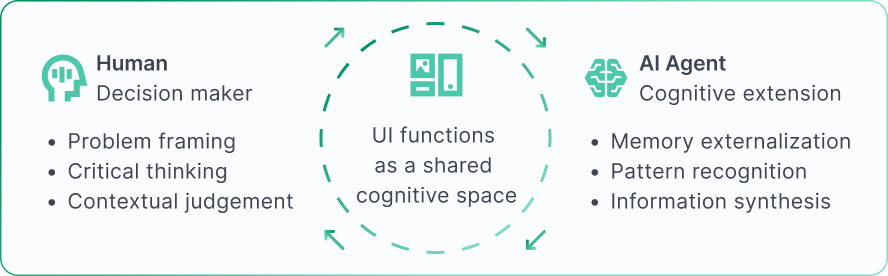
We design agents to be extensions of a user's cognitive system; partners capable of externalizing thoughts. We aim to enhance users' problem-solving skills by providing the information they need to assist in decision making.

Cognition is always context-dependent. Our agents are designed to operate within these messy, dynamic contexts—recognizing timing, environment, and cues to deliver support that feels timely, appropriate, and relevant to the moment.

We believe in agentic systems that respond to physical cues—gesture, rhythm, spatial layout—and acknowledge the sensorimotor dimensions of work. We are currently working on Agents that can pick up on these cues and relate in real time.
We focus on creating agents that participate within human thinking processes instead of functioning as independent utilities. These agents act as cognitive partners that help articulate, organize, and extend ideas, supporting users as they reason, explore, and make sense of complex problems. The intent is not to automate human cognition, but to amplify it—enabling richer forms of understanding and collaboration.
In Designing agentic systems we consider cognitive processes to be distributed across human and AI agents working within the unified system. This helps us to conceptualize experiences that allow agents to seamlessly integrate into user workflows and interfaces that act as spaces of mutual sense-making and collaboration.

Sumarizing

Remembering

Suggesting

Contextualizing
The agent isn't just a tool—it's an extension of the cognitive system, actively participating in thought processes. Design must therefore support co-thinking, where human and AI shape ideas together.

Designing agent interactions that help users navigate multi-agent troubleshooting through guided, collaborative sensemaking.

Coming Soon
Cognition is shaped by context. Users rarely execute fixed plans all of the time—they adapt in real time to their surroundings, constraints, and evolving goals. Our agents are built to thrive in these fluid, unpredictable settings—sensing timing and environmental cues to provide assistance that feels natural, situationally aware, and attuned to the moment.
Agents that improvise and adapt based on environment, timing, and social context—not rigid plans.
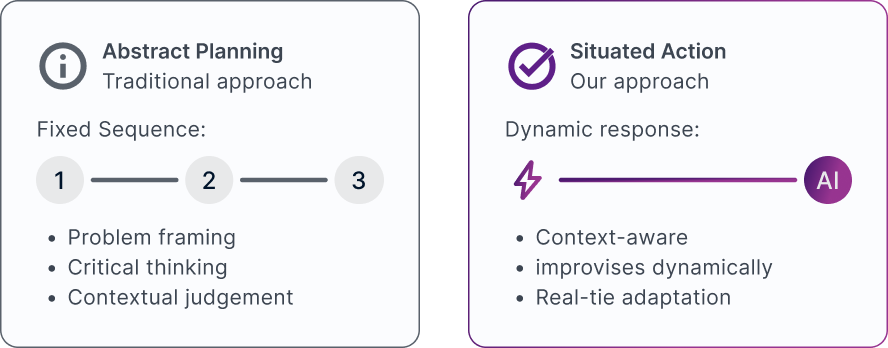
Intelligence emerges from ongoing interaction with dynamic contexts, not from executing predetermined plans. For designers, this means creating systems that remain open, adaptive, and responsive—shaping intelligence through interaction rather than instruction.
Thinking does not reside solely in the brain—it unfolds through movement, rhythm, and our engagement with space and tools. Cognition is embodied: it happens as we gesture, coordinate, and attune to the world around us. We design agentic systems that recognize these sensorimotor dimensions of thought—systems that seek to pick up on subtle cues of motion, rhythm, and spatial context to collaborate more intuitively with humans. Our current work explores agents capable of perceiving and responding to these embodied signals in real time, bridging the gap between mind, body, and machine.
Thinking happens through the body—agents can respond to physical, spatial, and temporal cues.
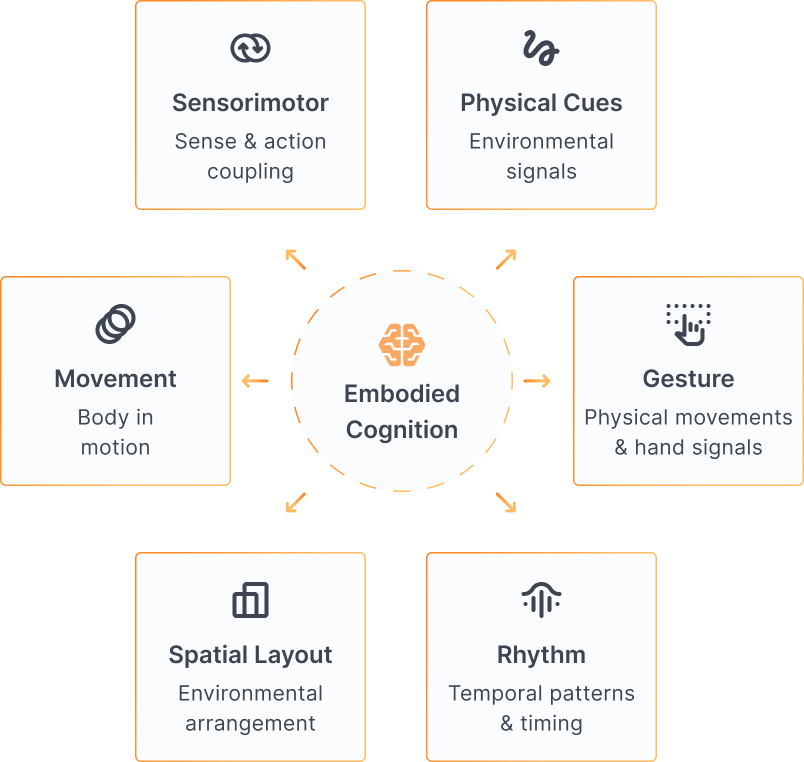
Cognition extends beyond the brain into physical gestures, spatial arrangements, and temporal rhythms of interaction. When designing agents that interact with users in the real world, we must consider how these embodied and environmental dynamics shape meaning, attention, and action—ensuring that agents respond not just to words, but to movement, rhythm, and context as part of the cognitive process itself.
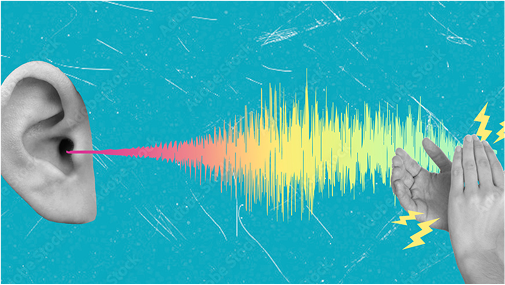
TMEET is a research initiative aiming to develop a framework for embodied digital communication.